

From Scotland
Fish and Ships

I’m not entirely sure why I think of Scotland as home. I wasn’t born there - I was born in the newly designated shithole of a country known as America. Of my sixty-five years, I have lived roughly forty-four of them in England. My parents are, or were, from Nottingham. But the sixteen years from the age of five to the age of…erm…(counts on fingers)...twenty-one are such formative ones that, for me at least, that’s where my roots seem to have dug themselves most deeply into the soil. And I do have a Scottish surname thanks to my paternal Grandfather who was properly Scottish. An alcoholic to boot.
Boarding the plane from Heathrow to Edinburgh already felt like stepping into a different, altogether more civilised, not to say better world. “There’s no hurry, take your time,” as people loaded their luggage into the overhead lockers. “Can I help you there?” A welcome change from the usual passive-aggressive sighing and rolling of the eyes.
Then the bus from Edinburgh airport into the city, the cheerful and friendly driver checking that I knew where I was going and that I did indeed only need a single ticket, for why should anyone ever want to leave? (Very Brigadoon.)
Determined little rays of sunlight succeeded in wriggling their way through the clouds and cast a golden light upon the zoo, upon Murrayfield, upon Haymarket, like a minister bestowing his blessing upon the congregation. Jolly good job I savoured it because that was the very last glimpse of sun to be had for the rest of my stay.
In Edinburgh, I enjoyed a joyous get-together over coffee and cake with my favourite writer and illustrator of children’s books, before catching the train to Leuchars where I was met by my sister and her husband.
As I said in my previous unmissable missive - you may have missed it - my sister and I are both researching novels based in the sometimes wild but always beautiful East Neuk of Fife. (Thankfully, our two oeuvres are set in different eras; otherwise, despite our grizzled years, the levels of sibling rivalry might prove hazardous to innocent bystanders.)
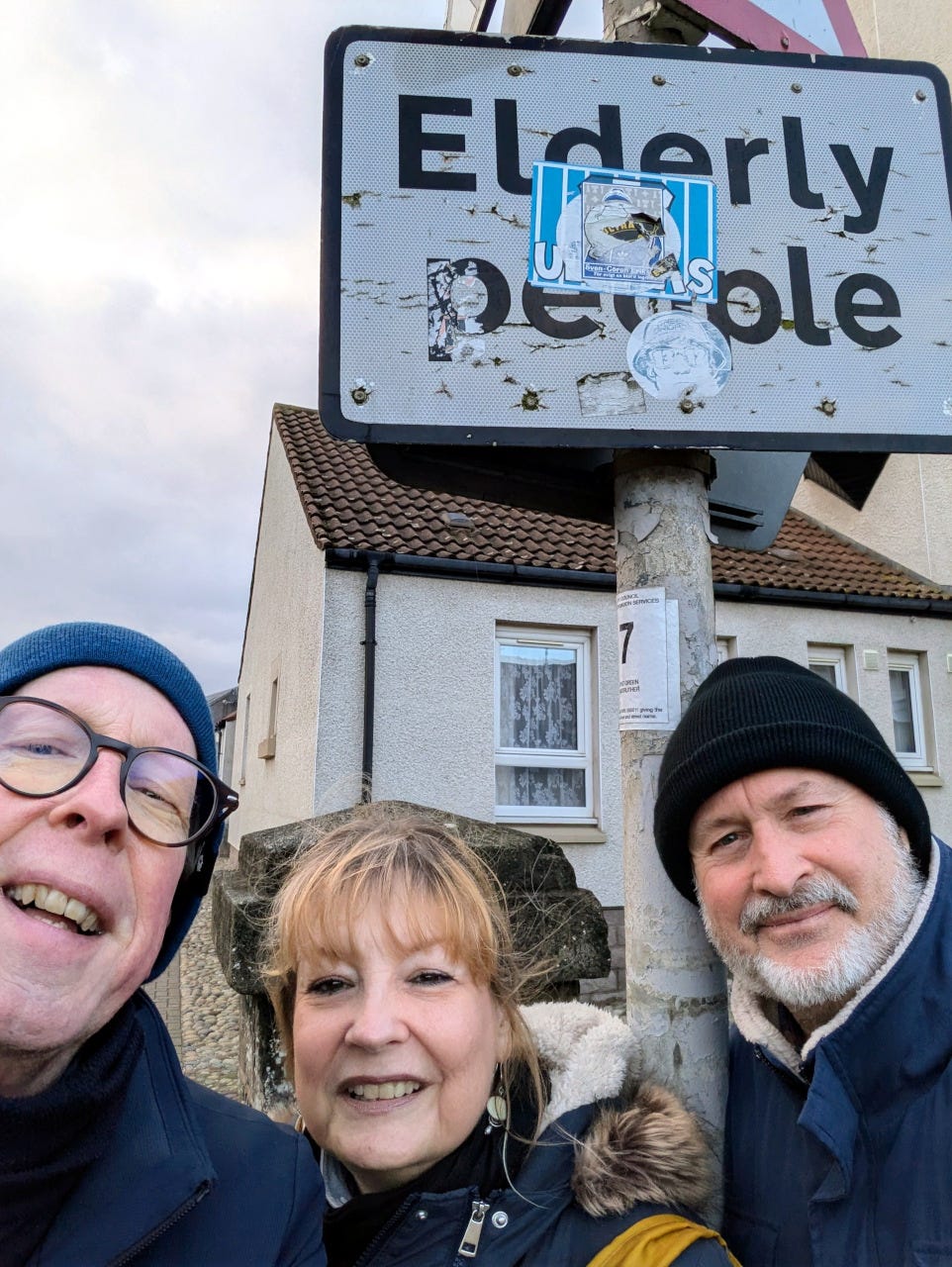
As the sky darkened and the breeze sharpened, we took an early evening walk through the narrow streets of Cellardyke and on towards the harbour of Anstruther.
When we first moved there in 1965, Anstruther was still very much a working fishing port. It never had a fish auction shed like the neighbouring village of Pittenweem to the west but nevertheless, of the considerable number of vessels moored there, most were drifters or trawlers, some of which would sail remarkable distances out into the North Sea in the inordinately dangerous pursuit of cod, haddock and other whitefish, all to satisfy the insatiable desire for deep-fried food wrapped in paper. These days, Anstruther harbour is little more than a marina sheltering yachts and other pleasure craft, although a clutch of small working boats remains, heading out to catch crab and lobster in comparatively benign inshore waters.
It is also home to “Reaper”, a magnificently restored early 20th-century type of sailing fishing boat known as a Fifie. The Fifie is of historic significance in these parts because it enabled the fisherfolk of the East Neuk to exploit the staggeringly huge shoals of herring that migrated in those times from the Shetlands, down the east coast of Scotland and onwards to the great Suffolk ports before dispersing, only to reappear the following spring. It was an unusual boom time for these parts, bringing considerable prosperity for the best part of a hundred years and stamping an indelible mark on the history of the area.
Like so many things that seemed never-ending to the Victorians, the resource proved finite after all, and now there are no herring left in the Firth of Forth. None. Nada. Well…maybe one or two, but they’re pretty lonely and have no friends. Billy-No-Matjes.
Two things about the Fifie. One is that it represented a leap forward in boat design, allowing courageous fishing crews to venture further and faster than they had ever managed before. The other is that it features significantly in the novel I am currently working on, all about the Great Herring Boom of the late 19th century.
When people ask me what I’m working on at the moment and I reply it’s a historical novel about herring, I can’t say, in all honesty, that I’m met with a huge wave of enthusiasm. Of course, it’s about so much more than that. But then you knew that, didn’t you? Didn’t you?
It’s about struggle and love and peril and succeeding despite all the odds. And it’s jolly exciting, I can tell you. Especially the bits about herring. Full of feats of herring-do you might say, but wouldn’t if you had any sense.
Here is Reaper lying quietly at berth.
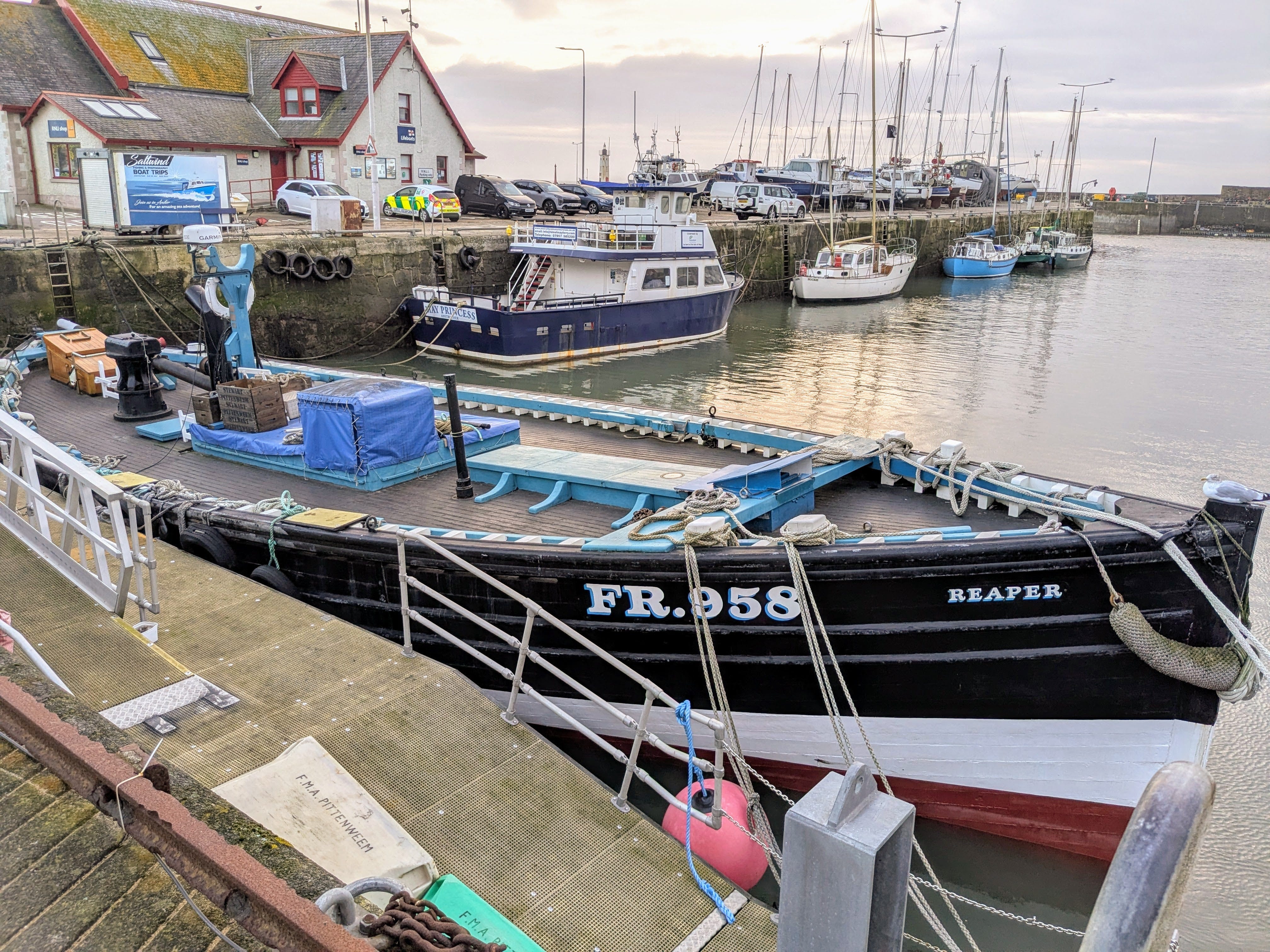
She was first registered in Fraserburgh in 1902 and was what is known as a two-masted sailing lugger. Which means, naturally enough, that she was originally powered by sail and sail alone, which is pretty mind-boggling when you think of how far away the Shetland Islands are from the east coast of Fife and how fearsome the weather in the North Sea can be.
It is now owned by The Scottish Fisheries Museum, located just over the road from Reaper’s berth. Both my sister and I worked there during school holidays when we were teenagers, and not having visited since then, I can tell you that it’s grown to about ten times the size. (The museum, not my sister – do behave.) An absolute must-see if you’re in the neighbourhood.
Someone else who worked there while at school is a lovely chap by the name of Richard Weymss. Not only did he work at The Scottish Fisheries Museum, but when he was still in his late teens, he was appointed as its curator. A true polymath and leading historical authority on the area, he is chairman of The Cellardyke Trust and also heads up a project to restore another old boat, The Manx Beauty, of which I will write more another time. It was my pleasure to take him for dinner and pump him with questions in my pursuit of ensuring the verisimilitude of what I’m writing. He gave of his knowledge with great generosity and continues to do so.
And speaking of acts of generosity, my novel references a grand country house which lies within the East Neuk. Again, I wanted to check that my historical research is accurate, but it is a private house, not open to the public, and therefore not accessible to the great unwashed such as I. Nevertheless, and on the off-chance, I wrote a cheeky email to the estate manager who very politely explained that it wouldn’t be possible. So I left it at that.
But then, blow me down with a feather, my phone rang and who should it be but the co-owner of the house, inviting me and my sister and brother-in-law to come for a cup of tea and to view the property. Both she and her husband were magnanimous in the time they gave us, providing us with a tour of the sumptuous interior and heaps of historical detail. They are clearly proud of the conservation work they have done and keep on doing, and quite right too. But it’s their family home, so to allow us access in such an unfettered way was very touching.
It put the cherry on top of what was already proving to be a pretty fabulous trip. If the trip had been a cake. Which it wasn’t. Although it was a piece of cake. (You may regard this as jolly witty and clever metaphor juggling - or you may regard it as me jerking off…literarily.)
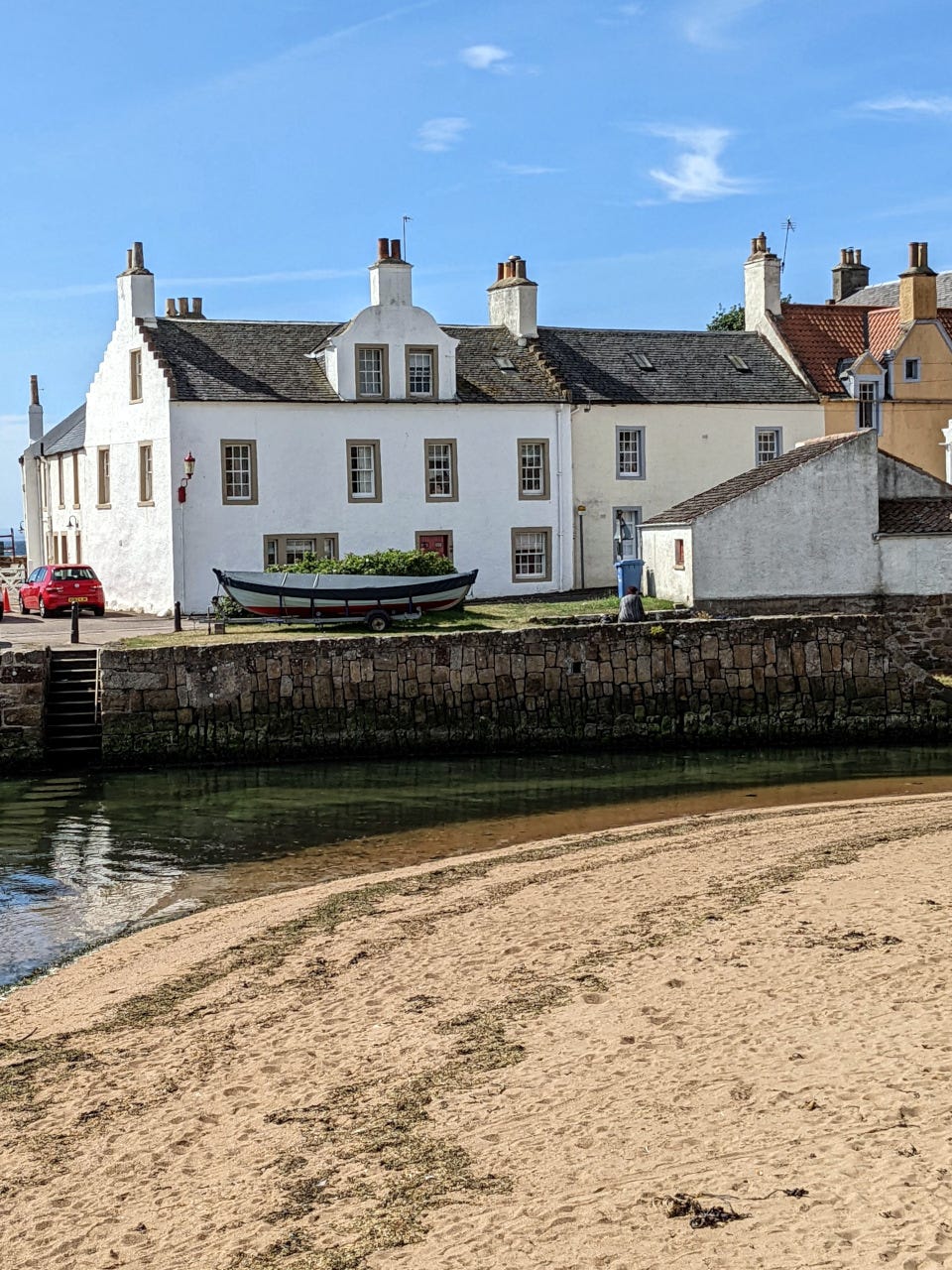
The other house we were able to visit was the one that my sister and I grew up in. Possibly originally constructed as three small dwellings with some fish and equipment storage below, it was converted into a single grand house for Sir Henry Erskine in 1760 (a number I always remember because it’s the same as the number of yards there are in a mile, if yards are your thing). It sits majestically on the old harbour in Anstruther overlooking the Dreel Burn as it babbles its way seawards.
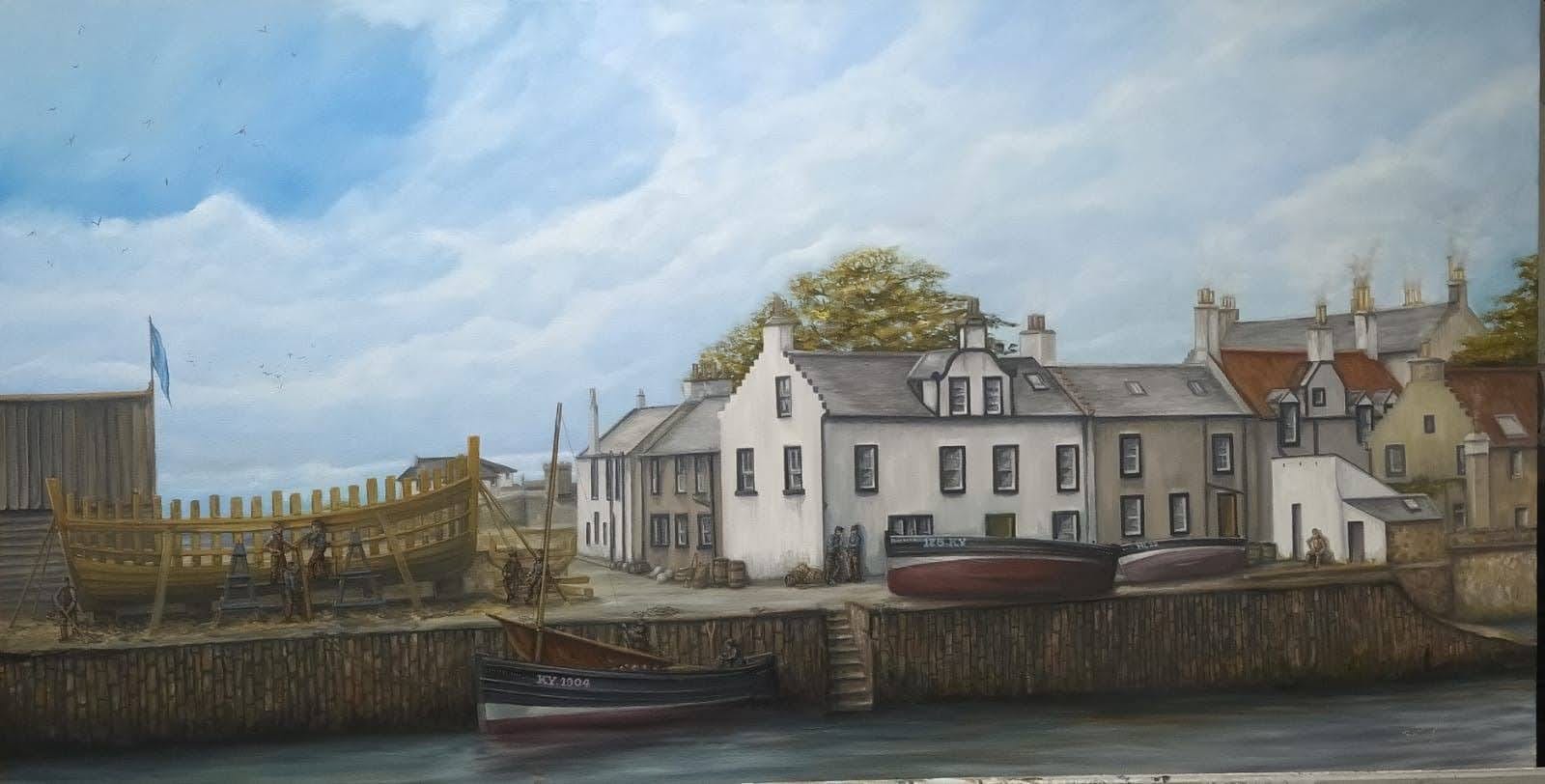
Known as The White House, by the mid-19th century, it had fallen into a bit of a sorry state but our parents saw its potential, and in 1965 bought it for six shillings and a bag of gob-stoppers, and then embarked on a lengthy restoration in partnership with the National Trust for Scotland’s Little Houses Improvement Scheme - indeed it was the first ever property to benefit from that initiative.
The structure of the house we grew up in has changed substantially over the ensuing years and now constitutes two private houses and two rental properties. On this trip, we were able to access the middle part - the heart of the building. The last time I had stood there in that hallway with its Robert Adam fireplace decorated with pretty Delft tiles was 36 years ago. Memories came flooding back of family and school and friends and of my school rock bands that rehearsed there noisily and badly. And of my first yearnings that very occasionally developed into clumsy fumblings with bonnie young queans who gave of themselves so far but not an inch further. (Quite right too.)
It had its faults, the East Neuk, but it was a grand place to grow up and is a grand place in which to set two forthcoming novels from the Mackintosh siblings. We shall both keep you posted on our gallop to the finishing post.
Place your bets!
What a lovely piece that makes me long to be by the coast! I'm looking forward to learning more about your novel as and when you share those details. In the meantime, I'll have to look into the herring boom...
I feel like I know you, Andrew--not just from your sister but especially from reading this conversational piece. How interesting about the White House! You and Fiona had a very interesting upbringing. I look forward to both of your novels.